
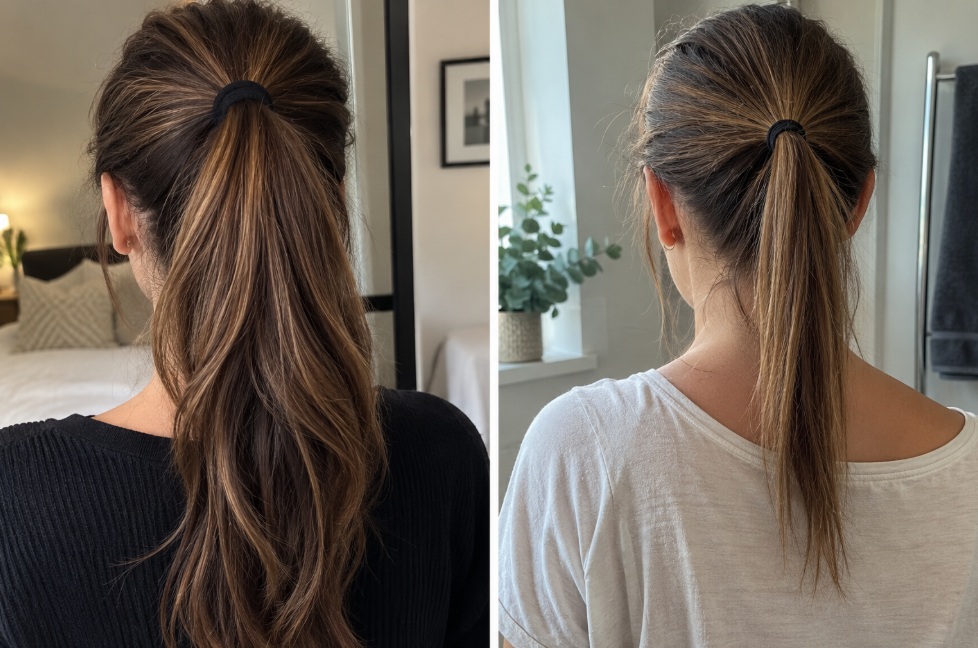
Why Has My Ponytail Become Thinner Even Though I’m Not Shedding Much Hair?
You tie your hair back and something feels different.
The hairband goes around one more time than it used to. Your ponytail doesn’t feel quite as substantial in your hand. Perhaps it looks narrower in photographs, or you have noticed that it no longer has the same weight and fullness it once did.
But here’s the confusing part: you’re not actually shedding much hair.
There aren’t clumps coming out in the shower. Your brush isn’t suddenly full of hair. You’re not finding alarming amounts on your pillow or clothes.
So, where has the hair gone?
A thinner ponytail without obvious excessive shedding is surprisingly common, particularly among women experiencing the early stages of reduced hair density. And while shedding can certainly cause a ponytail to become smaller, it isn’t the only explanation.
Sometimes, the change happens far more gradually.
Can Your Hair Get Thinner Without Shedding More?
Yes.
Hair density isn’t determined simply by how many hairs you notice falling out each day. It is also influenced by how many hairs are actively growing, how long they remain in the growth phase, and — importantly — how thick each individual strand becomes.
Imagine a ponytail containing roughly the same number of hairs as before, but a proportion of those hairs are now finer.
The ponytail will feel smaller.
This is one reason women can experience genuine hair thinning without ever going through a dramatic period of shedding.
Hair loss is often imagined as an event: lots of hair suddenly falling out. In reality, some of the most common forms of female hair thinning are slow, subtle and remarkably easy to miss in their early stages.
The shrinking ponytail may be one of the first clues.
Look at the Individual Hairs, Not Just the Hair You’re Losing
Take a closer look at the hair around your parting and the top of your scalp.
Are all the strands roughly the same thickness?
Or are there increasingly fine, wispy hairs mixed among stronger ones?
This difference matters.
In female pattern hair loss, susceptible follicles can gradually produce hairs with a smaller diameter. This process is commonly referred to as follicular miniaturisation.
Instead of a follicle suddenly stopping hair production altogether, the change can occur over successive growth cycles. A strong terminal hair may gradually be replaced by a finer one.
That finer hair still counts as a hair.
You can still brush it, wash it and put it into a ponytail.
It simply contributes less volume.
Multiply that change across thousands of follicles and the overall effect can become noticeable even when your daily shedding doesn’t appear particularly unusual.
The Ponytail Can Reveal Changes Before the Mirror Does
One of the frustrating things about gradual female hair thinning is how well it can hide.
You see yourself every day. Small changes are difficult to detect when they happen over months or years.
Hair can also be remarkably good at disguising reduced density. A different blow-dry, freshly washed hair, dry shampoo, curls or simply changing your parting can make it look considerably fuller.
A ponytail is less forgiving.
When all of your hair is gathered together, the combined thickness of those strands determines the circumference of the ponytail. If individual hairs become finer, fewer hairs are actively growing, or breakage reduces the number of full-length strands reaching the ponytail, it can gradually become smaller.
Some women notice this long before they would describe themselves as having “hair loss”.
They simply know that they used to have more hair.
Does a Thinner Ponytail Mean Female Pattern Hair Loss?
Not necessarily.
Female pattern hair loss is one possible explanation, but ponytail thickness alone cannot tell you why your hair has changed.
There are several possibilities.
Female Pattern Hair Loss
Female pattern hair loss tends to cause progressive reduction in hair density, often most noticeably over the top and central areas of the scalp.
A widening parting is a classic sign, but not every woman initially notices an obvious change to her part.
Instead, the first signs can be frustratingly vague: less volume, finer hair, more visible scalp under strong lighting, or a ponytail that simply doesn’t feel as thick as it once did.
Because the process can be gradual, excessive shedding isn’t always the symptom that draws attention to it.
Age-Related Changes in Hair
Hair at 40, 50 or 60 isn’t necessarily going to behave exactly as it did at 20.
Hair diameter, growth cycles and density can change with age. Some women find their individual strands become finer, while others notice that their hair doesn’t grow with quite the same vigour or fullness.
This can happen gradually enough that there is no obvious point at which the hair suddenly became thinner.
You may simply compare your ponytail with how it felt several years ago and realise there is a difference.
Hormonal Changes
Hormones can have a significant influence on the hair cycle, which is why women may notice changes during or after pregnancy, around perimenopause and menopause, or following other hormonal changes.
The effect isn’t identical for everyone.
For some women, increased shedding is obvious. For others, the more noticeable long-term change is a reduction in density, particularly around the top of the scalp and parting.
Previous Shedding You Didn’t Notice
It is also possible that you did lose more hair — just not dramatically enough to realise it.
Not every episode of increased shedding results in handfuls of hair coming away in the shower.
Hair cycling occurs over a long period, and relatively modest increases in shedding can accumulate. If replacement growth doesn’t keep pace, overall density may slowly decrease.
By the time you notice that your ponytail is smaller, the event that contributed to the change may have happened months earlier.
Hair Breakage
Not every smaller ponytail originates at the follicle.
Run your hands through the lengths of your hair and look for shorter, broken strands.
Frequent bleaching, colouring, heat styling, chemical treatments and mechanical damage can weaken the hair shaft. When strands break before reaching their full length, less hair makes it into the ponytail.
This can produce an important distinction:
Your scalp may still be growing plenty of hair, but fewer strands are surviving at full length.
If the roots and parting still look dense while the lengths have become progressively thinner, damage and breakage deserve consideration.
What About a Thinner Ponytail During Perimenopause or Menopause?
This is a particularly common concern.
Many women first become aware of changes to their hair during their 40s and 50s. The complaint isn’t always “my hair is falling out”. Quite often it is something less dramatic:
“My hair just isn’t as thick as it used to be.”
Changes associated with ageing and the hormonal transition around menopause can affect the hair’s growth cycle and diameter. Female pattern hair loss may also become more apparent during this period in women who are genetically susceptible to it.
That doesn’t mean every woman who develops a thinner ponytail during menopause is developing permanent hair loss.
It does mean that a persistent change is worth looking at as a density issue, rather than dismissing it simply because you’re not seeing excessive shedding.
Check Your Parting as Well as Your Ponytail
If your ponytail has noticeably changed, your parting can provide another useful clue.
Look at photographs taken several years apart if you have them.
Has the central part become wider?
Can you see more scalp around the crown?
Does the hair immediately behind the frontal hairline appear less dense?
Does bright overhead lighting reveal considerably more scalp than it used to?
Old photographs are often more useful than repeatedly checking the mirror because they provide a genuine point of comparison.
Try to compare like with like. Wet hair, oily hair and harsh overhead lighting can make virtually anyone’s scalp appear more visible.
One photograph taken under an unforgiving bathroom spotlight isn’t evidence that you’re losing your hair.
A consistent change over time is far more meaningful.
Should You Measure Your Ponytail?
You can, but don’t become obsessed with it.
Some women measure the circumference of their ponytail to monitor density. In principle, this can provide a rough reference point, but it isn’t a precise diagnostic test.
Where you position the ponytail, how tightly you secure it, whether the hair is freshly washed, how much product is present and even whether you’ve recently had a haircut can alter the measurement.
If you want to monitor your hair, photographs are usually more useful.
Take pictures of the centre parting, temples, crown and ponytail under similar lighting every few months.
You’re looking for a trend — not a millimetre-by-millimetre change from one week to the next.
Hair simply doesn’t move that quickly.
Can a Thinner Ponytail Become Thick Again?
That depends entirely on why it became thinner.
If reduced density followed a temporary disturbance to the hair cycle, recovery may occur as normal growth resumes. If breakage is responsible, improving the condition of the hair and reducing damaging practices can allow more strands to reach their full length.
Progressive female pattern hair loss is different.
Because follicular miniaturisation can continue over time, early recognition matters. Treatment is generally aimed at preserving existing hair and encouraging stronger growth from follicles that are still capable of producing it.
This is why waiting for hair loss to become “bad enough” to do something about it isn’t always the best approach.
You don’t need to be losing handfuls of hair before a change is worth investigating.
When Should You Speak to a Doctor or Hair-Loss Specialist?
A slightly smaller ponytail on its own isn’t a medical emergency.
But seek professional advice if the loss of density is persistent, worsening or accompanied by other changes.
This is particularly important if you develop bald patches, scalp pain, redness, significant itching or scaling, loss of eyebrows or other body hair, or very rapid hair loss.
A doctor may also consider whether factors such as iron deficiency, thyroid problems, nutritional deficiencies, medication, illness or hormonal changes could be contributing.
And if you’re unsure whether you’re experiencing breakage, shedding or progressive thinning, a dermatologist with an interest in hair disorders can examine the scalp and hair much more closely than you can in the bathroom mirror.
Don’t Wait for the Shower to Tell You You’re Losing Hair
Perhaps the biggest misconception about female hair loss is that it must involve dramatic shedding.
It doesn’t.
For some women, there is no frightening handful of hair in the shower and no brush suddenly overflowing with strands.
The change is quieter than that.
The ponytail gets a little smaller. The parting becomes slightly more visible. The hair doesn’t hold volume quite as well. Styles that once looked full start to fall flatter.
None of these things automatically means you have female pattern hair loss.
But if your ponytail has genuinely become thinner over time, don’t dismiss the change simply because you’re not shedding heavily.
The amount of hair you lose is only one part of the picture.
Sometimes, the hair you’re still growing tells you much more.

Leave a Reply