Beyond the Hype: A Critical Analysis of MONAT, Hair Loss Claims, and the MLM Model
Hair loss in women is rarely just a cosmetic inconvenience; it is often a deeply personal, distressing experience linked to identity, confidence, and stress. It is precisely within this vulnerable space that MONAT—a global direct-sales beauty brand—has built a multi-million-pound presence.
Scroll through Instagram or Facebook, and you will see two fiercely opposing camps. On one side, enthusiastic Market Partners post high-gloss “before and after” photos, praising the products as transformative hair-care miracles. On the other, vocal critics warning of scalp irritation, shedding, and predatory marketing tactics.
Behind the social media commentary lies a question every consumer ought to ask before opening her wallet: What level of clinical and scientific evidence should a woman experiencing hair loss demand from a shampoo line?
Enjoying a premium shampoo for its fragrance and lather is simple enough. Recommending that same shampoo to a woman worried about her thinning parting carries an entirely different level of accountability. To separate marketing strategy from clinical reality, we must unpack MONAT’s commercial structure, its regulatory history, and the fine print behind its headline claims.
1. The Direct-Sales Blueprint: Why the Business Model Matters
MONAT operates through independent representatives known as Market Partners. Under its corporate structure, representatives earn money through two primary streams: direct retail commissions on product sales, and recruitment bonuses from building a “downline” of secondary sellers. This is the classic Multi-Level Marketing (MLM) framework.
Why does this financial architecture matter to a customer seeking advice on hair thinning?
When you consult a medical professional or a qualified trichologist, their primary duty of care is your clinical outcome. They do not lose their income if they tell you that a £60 serum cannot restore your follicles.
In an MLM framework, however, every interaction is inherently commercial. A Market Partner may sincerely love the products they sell—personal conviction and financial incentive frequently coexist. But the structural incentive to sell remains paramount.
Before acting on a friend’s or influencer’s recommendation, consumers should feel comfortable asking three baseline questions:
- Do you earn a direct commission if I buy this product or join your team?
- What formal training or clinical qualifications do you hold in trichology or dermatology?
- Are you recommending this product based on my specific diagnosis, or because it is the solution your catalog provides?
A reputable seller operating with integrity will answer these without hesitation or defensiveness.
2. Navigating the Controversy: Lawsuits, Settlements, and Facts
Search MONAT online and you will quickly hit references to legal battles and regulatory scrutiny. Understanding what actually happened requires distinguishing between online rumor and documented legal record.
The 2018 Class Action Allegations
In 2018, MONAT faced multiple class-action lawsuits in the United States alleging that its products caused severe scalp irritation, sores, and accelerated hair loss. It is crucial to understand the legal context: a lawsuit represents allegations brought by plaintiffs; filing a claim is not proof of causation. MONAT consistently denied these claims, asserting that its products were safe and rigorously tested.
No court has ruled against MONAT on the merits of those personal-injury claims.
The 2020 Florida Attorney General Agreement
The more definitive legal milestone occurred in September 2020, when MONAT entered into a Voluntary Compliance Agreement with the Florida Attorney General’s Office. Following an investigation into the company’s business practices, the AG’s office highlighted issues concerning:
- How product efficacy and ingredient benefits were advertised.
- Substantive proof behind claims of hair regrowth and health benefits.
- Clear disclosure of auto-ship terms, recurring billing, and discount rules.
Under the agreement, MONAT paid over $250,000 in costs and agreed to refund affected customers who had submitted eligible complaints. Crucially, the agreement required MONAT to refrain from making deceptive representations about product safety, scientific substantiation, or guaranteed hair growth unless backed by rigorous, independent testing.
Note for consumers: The refund window tied to that 2020 settlement closed in February 2021. It is a historical regulatory outcome, not an ongoing claims fund. It serves as a reminder that consumer protection authorities actively monitor cosmetic claims—and that buyers should approach bold claims with healthy skepticism.
3. Dissecting the “92% Less Hair Fall” Claim: Read the Fine Print
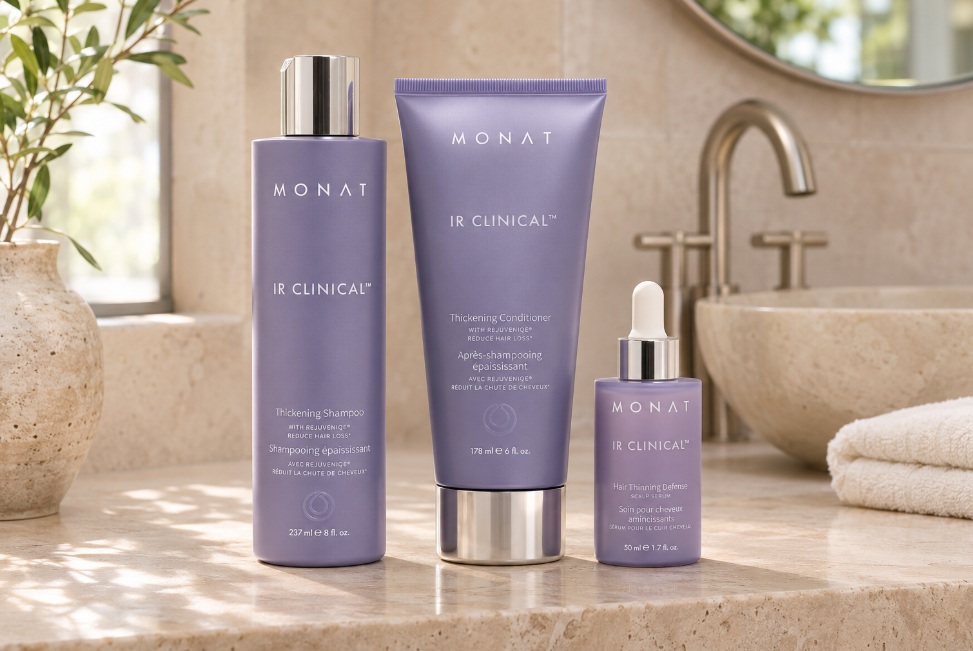
One of MONAT’s marquee products, the IR Clinical™ Hair Thinning Defense Scalp Serum, carries bold marketing claims on its UK storefront—most notably a 92% reduction in hair fall.
To an individual anxious about seeing excess hair in their shower drain, “92% less hair fall” sounds like a near-complete stop to thinning. But a closer look at the footnoted study methodology tells a very different story.
+----------------------------------------------------------------------------------------------------+
|  Headline Claim: "92% Less Hair Fall"                                                              |
+----------------------------------------------------+-----------------------------------------------+
|  What the Consumer Hears                           |  What the Footnote Discloses                  |
+----------------------------------------------------+-----------------------------------------------+
|  "My hair will stop shedding from the root."       |  Reduction in hair breaking during physical    |
|                                                    |  combing and brushing in a lab test.          |
+----------------------------------------------------+-----------------------------------------------+
|  "This product causes new hair follicles to grow." |  Instrumental measurement of hair fiber       |
|                                                    |  diameter (swelling the hair shaft).          |
+----------------------------------------------------+-----------------------------------------------+
Shedding vs. Breakage: A Critical Distinction
There is a fundamental biological difference between follicular hair loss (such as androgenic alopecia or telogen effluvium) and mechanical hair breakage:
- Hair Loss (Shedding): Occurs at the root beneath the scalp, driven by hormones (like DHT), nutritional deficiencies, auto-immune responses, or cellular stress cycles.
- Hair Breakage: Occurs along the hair shaft due to mechanical friction, chemical treatments, heat styling, or dryness.
Reducing breakage during a standardized combing test means the product acts as an effective conditioning agent, smoothing the cuticle so the comb glides easily. It does not mean the serum has altered the biological signals governing hair follicle growth, nor does it mean it stops hormonal shedding.
If your parting is widening because of an internal health shift or genetic thinning, a product that simply prevents strands from snapping under a comb does not address the underlying cause.
4. Ingredients vs. Formulations: Clinical Proof vs. Consumer Perception
The IR Clinical Serum list highlights ingredients like caffeine, melatonin, and CAPIXYL™ (a complex containing acetyl tetrapeptide-3 and red clover extract).
These ingredients are supported by early-stage in-vitro studies and small clinical trials when tested individually at specific concentrations. However, presence in an ingredient list does not automatically guarantee efficacy in a finished retail formula.
Furthermore, MONAT cites a consumer perception trial in which 8 out of 10 participants felt the serum improved hair growth after 60 days (based on a sample size of 39 women).
When evaluating such claims, consider the scientific hierarchy of evidence:
- Perception vs. Objective Measurement: Asking 39 people if their hair “feels thicker” yields subjective opinion. It is susceptible to the placebo effect and personal bias, especially when participants are invested in the outcome. It is not equivalent to a double-blind, phototrichogram study measuring actual hair count per square centimeter.
- Sample Size: A study of 39 individuals is an exploratory pilot test, not a definitive clinical standard for medical claims.
- Control Groups: Was the product tested against a placebo vehicle serum, or was everyone given the active bottle knowing what it was supposed to do?
5. MONAT’s Own Compliance Rules Set the Boundary
Interestingly, MONAT’s corporate policy and UK compliance guidelines state explicit boundaries that Market Partners are required to follow:
MONAT products are cosmetics, not medicines. Market Partners are strictly prohibited from stating or implying that MONAT products diagnose, treat, cure, mitigate, or prevent any medical condition or disease—including alopecia, medical hair loss, or scalp pathologies.
This rule exists for a reason: under UK and EU cosmetic regulations (as well as US FDA law), claiming a product changes body structure or cures a physiological condition reclassifies that product as a drug or medical device, subjecting it to stringent clinical trial requirements.
If a seller sends you a private message featuring dramatic photo collages and claiming that a MONAT routine will “cure your alopecia” or “reactivate dormant follicles,” they are violating their own company’s compliance rules.
The Verdict: How to Approach MONAT for Hair Thinning
If you are considering MONAT products, framing your expectations accurately is key:
- As high-end cosmetic haircare: If you like how a shampoo cleanses your hair, improves shine, or reduces styling breakage, purchasing it for cosmetic enjoyment is entirely reasonable.
- As a medical hair loss treatment: If you are seeking a cure for hair thinning, a cosmetic line cannot replace evidence-based medical diagnostics.
Hair thinning in women can stem from thyroid dysfunction, iron deficiency, hormonal shifts, stress, or genetic pattern loss. Ordering expensive cosmetic shampoos without knowing the root cause delays appropriate care.
Before spending money on any multi-step haircare routine promoted through social networks, consult a registered dermatologist or trichologist. Your scalp deserves a clear diagnosis first—not a sales pitch. You are entitled to clear information, time to decide and a respectful answer when you ask for evidence.

Leave a Reply