
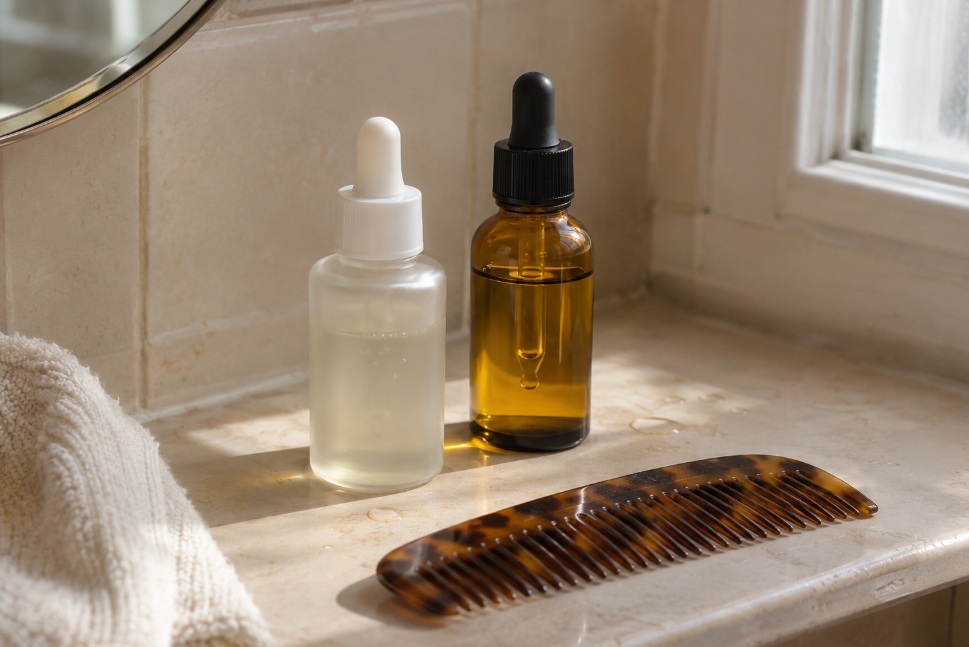
You buy a hair oil, use it faithfully, and your hair feels softer. Perhaps it looks shinier, too. But the reason you bought it—the parting that seems wider, or the ponytail that feels thinner—hasn’t really changed.
Was it the wrong product? Or were you expecting it to do something it was never designed to do?
For women shopping for thinning hair products, the distinction between a hair oil and a scalp serum can be surprisingly unclear. Both come in small bottles. Both may have a dropper. Both can carry the words “hair growth” on the label.
Before buying either, it helps to know where the product is meant to go and what it is actually formulated to do.
Hair growth serum vs hair oil: the main difference
A conventional hair oil is generally used to condition the hair, adding softness, shine or a smoother finish. A scalp serum is formulated for application to the scalp, with ingredients chosen for that purpose.
There are exceptions. Some oils are intended for scalp use, while some products called “hair serums” are simply styling products for the lengths and ends.
The name on the front of the bottle tells you less than the directions on the back.
If the instructions say to smooth a few drops through the ends, you are looking at a different kind of product from one that asks you to part your hair and apply it directly to the scalp.
That matters when your main concern is thinning rather than frizz.
What do you want your hair oil to do?
There is a place for a good hair oil. If you enjoy the finish it gives your hair, there is no reason to dismiss it because you are also concerned about thinning.
The difficulty comes when softer, glossier hair is confused with new growth. These are different outcomes.
Hair care that helps protect the strands from breakage can be valuable. The American Academy of Dermatology recommends gentle washing, conditioning and careful handling for people experiencing hair loss. But caring for the existing hair does not, by itself, establish that a product can regrow it.
Ask yourself what you are hoping to change. Dry ends? A rough texture? Hair that is difficult to manage? Or a gradual loss of visible fullness around the parting?
You may have more than one concern. You do not have to expect one bottle to address all of them.
What should you look for in a scalp serum for thinning hair?
Start with a clear description of the product’s purpose. You should be able to find out who it is intended for, where to apply it and how often to use it without searching through pages of marketing.
Then consider the practical details.
A formula intended for scalp application
A finishing serum that makes the hair look polished is not interchangeable with a scalp-care product. Look for explicit scalp application instructions.
Ingredients you can identify
A long ingredient list is not automatically more impressive than a short one. Look for an explanation of the main ingredients and their role in the formula.
Equally, the presence of a fashionable ingredient does not prove that the finished product will deliver a particular hair-growth result.
A texture that suits your routine
If you prefer washing your hair twice a week, consider whether the product’s directions fit that schedule. If your hair is fine, how it feels at the roots may matter just as much as how easily it applies.
A product needs to be practical enough for you to keep using it.
Sensible expectations
Be wary of treating “hair growth serum” as a guarantee. Cosmetic scalp care and medical hair-loss treatments are different categories, and the wording on a bottle is no substitute for evidence.
Where does HR23+ Copper Peptide Serum fit in?
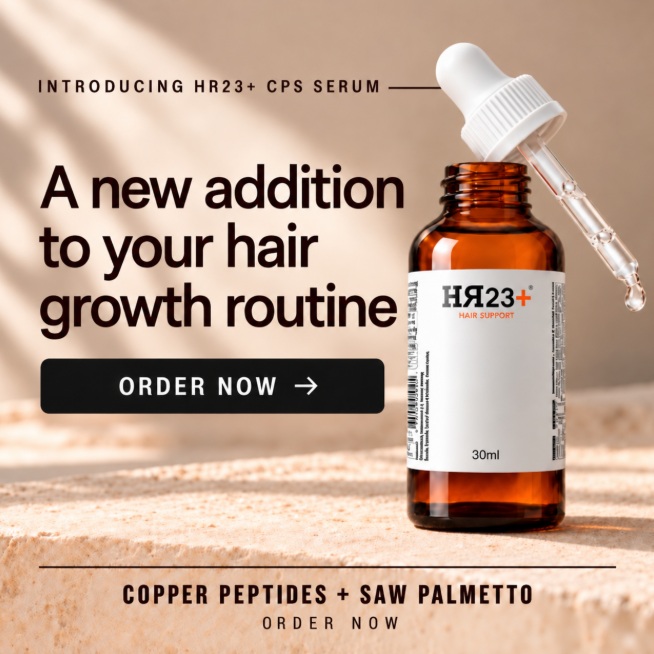
For women considering a dedicated scalp product, HR23+® CPS Serum is one option to explore.
The 30ml formula combines Copper Tripeptide-1, also known as GHK-Cu, with saw palmetto. HR23+ describes it as a lightweight, non-greasy serum developed for men and women concerned about thinning and reduced visible density.
It is applied directly to the scalp rather than smoothed through the ends as a finishing oil. The brand positions it as cosmetic support for scalp condition and stronger, fuller-looking hair. These are its intended benefits, rather than a guarantee of regrowth.
That makes CPS worth considering if you are looking specifically for a scalp serum and want to understand the formula before adding it to your routine.
You can read more about HR23+ CPS Serum and its ingredients here.
Can you use a scalp serum and a hair oil?
You do not necessarily have to choose between them. Begin by checking both products’ instructions, particularly if both are intended for the scalp.
An oil used on the ends and a serum applied at the roots have different application areas. Avoid assuming that layering several scalp products will improve their effects, though. A complicated routine can make it harder to identify which product suits you—or which one is causing irritation.
Keep the routine manageable and introduce changes carefully.
What if you already take the HR23+ supplement?
You can consider the serum separately rather than feeling you need to replace your existing routine.
HR23+ offers CPS as a standalone product or alongside its supplement. The distinction is straightforward: one is applied to the scalp; the other is taken orally. Using both does not guarantee a better result for every woman.
If you already take the supplement and are curious about topical scalp care, read the serum’s details and decide whether it fills a useful place in your routine.
So, which should you choose?
Choose according to the concern you want to address.
If you want a finishing product for softness and shine, look at hair oils formulated for that purpose. If you want to introduce scalp care, look at products specifically designed for direct scalp application.
For women exploring that second option, HR23+ CPS Serum offers a copper peptide and saw palmetto formula in a simple dropper format. Follow the pack instructions; the brand advises against use during pregnancy or breastfeeding.
And if you are worried about unexplained hair loss, seek advice about its cause before relying on another product. Understanding why your hair is changing makes it easier to choose appropriate care.
Explore HR23+ Copper Peptide & Saw Palmetto Serum →
Leave a Reply