
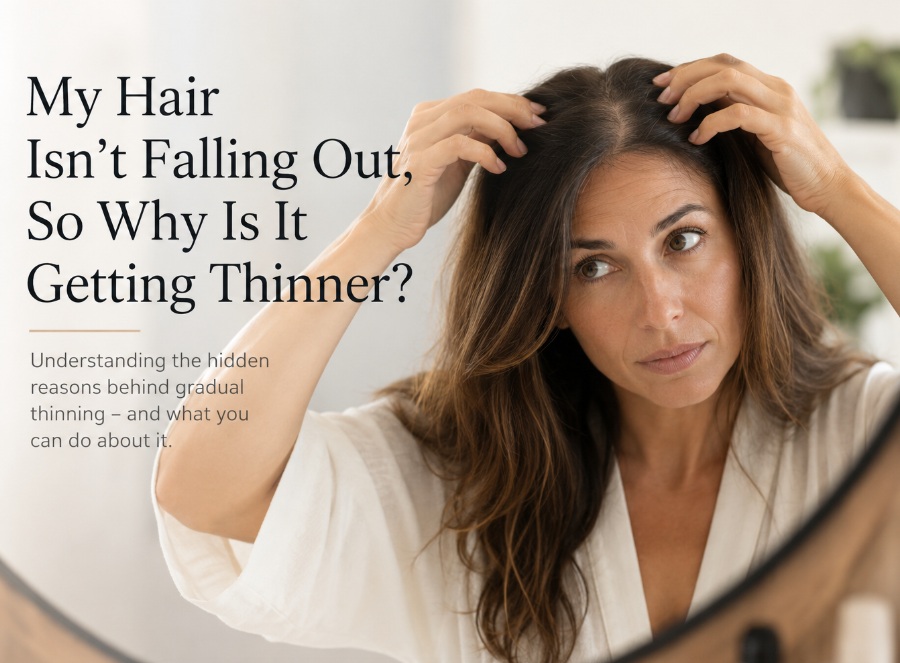
Hair thinning without hair loss? Here’s why…
Your hairbrush looks normal. You’re not finding handfuls of hair in the shower. Yet somehow, your hair looks and feels thinner than it used to.
Sound familiar?
Hair doesn’t always have to fall out dramatically for you to lose noticeable density. In fact, gradual thinning can be much more subtle.
Your Individual Hairs May Be Getting Finer
One possible explanation is hair follicle miniaturisation.
This is commonly associated with female pattern hair loss. Over time, affected follicles can produce progressively finer and shorter hairs. You may therefore notice a wider parting, more visible scalp or a smaller ponytail without experiencing an obvious increase in daily shedding.
It’s less about suddenly losing lots of hairs and more about the hairs you’re growing becoming less substantial.
Hormones Can Change Your Hair
Hair can also change considerably with age.
For many women, this becomes particularly noticeable during perimenopause and menopause. Hormonal changes can affect the hair cycle and contribute to reduced density and changes in the diameter and quality of individual hairs.
Your hair may still be growing, but it simply doesn’t feel as thick as it once did.
Don’t Confuse Breakage With Hair Loss
Another possibility is breakage.
Bleaching, frequent colouring, heated styling, extensions and repeatedly pulling the hair into tight styles can leave strands damaged and prone to snapping.
Look closely at the hairs you’re noticing. Lots of shorter, uneven strands can point towards breakage rather than hairs being shed directly from the root.
What Can You Do?
Start by being realistic about what has changed.
Compare photographs of your parting or hairline from a year or two ago. Reduce unnecessary heat and chemical damage, avoid tight hairstyles and make sure your diet provides adequate protein, iron and other important nutrients.
If you’re looking for additional nutritional support, a specialist hair supplement can also be incorporated into your routine.
HR23+ Hair Restoration Supplement is one of our preferred non-medicated options, combining vitamins, minerals, amino acids and botanical ingredients specifically formulated to support normal, healthy hair.
For female pattern hair loss, topical minoxidil is another established option worth discussing with a pharmacist, GP or dermatologist.
When Should You Get It Checked?
Gradual changes can be easy to dismiss, but don’t ignore thinning that continues to progress.
If you’re seeing significantly more scalp, your parting is becoming wider or your hair has changed noticeably without an obvious explanation, speak to your GP or a dermatologist. They can help determine whether you’re dealing with female pattern hair loss, a nutritional deficiency, hormonal changes or another underlying cause.
You don’t need to be shedding handfuls of hair to be experiencing hair loss. Sometimes the earliest sign is simply that your hair doesn’t feel quite as thick as it used to. And that’s exactly why gradual thinning is worth paying attention to early.
Leave a Reply