
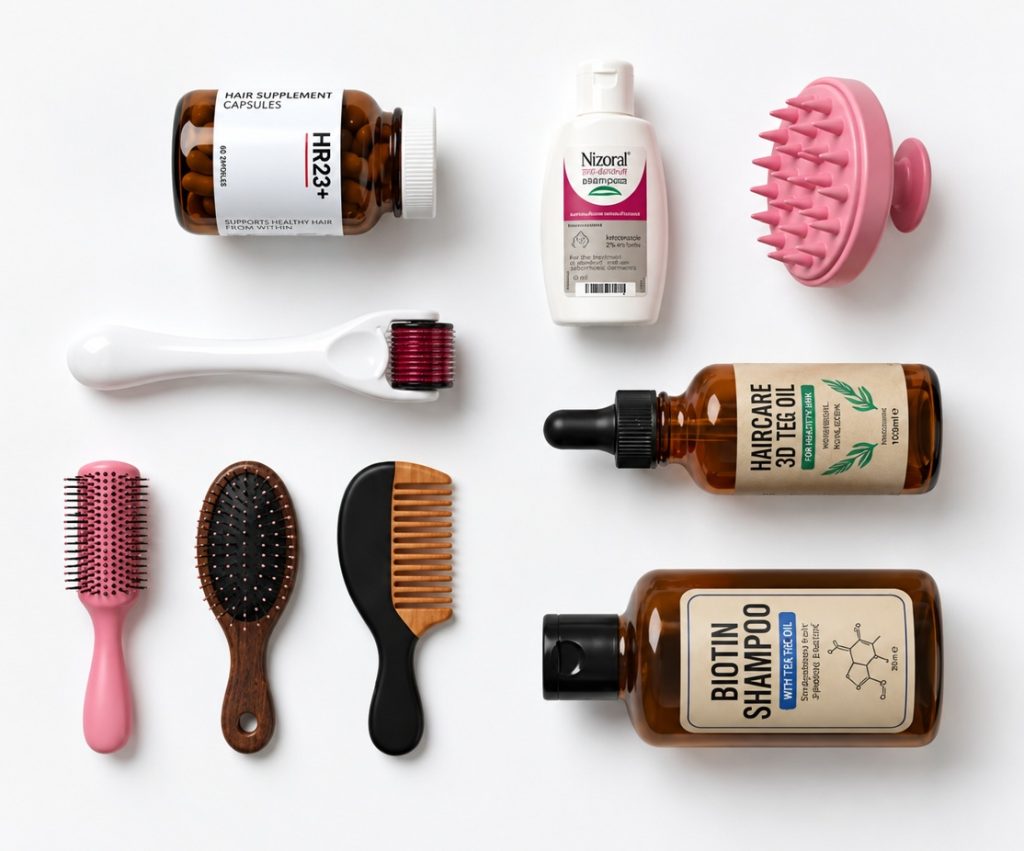
Hair loss has a habit of turning the bathroom into a laboratory.
Shampoos, supplements, oils, scalp brushes, rollers, serums. Before long, you can have half a dozen products on the shelf without really knowing what any of them are supposed to be doing.
So, what actually deserves a place in a female hair loss survival kit?
The answer depends on why you’re losing your hair. Female pattern hair loss, nutritional deficiencies, hormonal changes and temporary shedding can all require different approaches. And despite the enormous number of products marketed to women, topical minoxidil remains the treatment with the strongest clinical evidence for female pattern hair loss.
That doesn’t mean everything else is useless. Far from it. A sensible routine can combine nutritional support, scalp care and treatments that target different aspects of thinning.
Here are six products we think are genuinely worth knowing about.
1. HR23+ Hair Supplement
Best for: daily nutritional support and excessive shedding
A good hair supplement isn’t designed to magically force dormant follicles back into life. Its job is to make sure the follicle has a consistent supply of nutrients associated with normal, healthy hair growth, while combining them with other ingredients commonly used for thinning hair.
HR23+ is particularly interesting for women because its long-running customer feedback has historically been strong among female users. Early customer data reported a 91% repeat-purchase rate among women, while subsequent feedback across male and female users found that reduced hair fall was the most commonly reported improvement. These are customer-reported outcomes rather than placebo-controlled clinical trial results, which is an important distinction.
It’s therefore best viewed as the nutritional foundation of a wider routine rather than a medical treatment for female pattern hair loss.
The downside: Supplements need consistency, and they can’t correct an untreated underlying cause of hair loss simply by themselves.
2. Microneedling: Roller or Stamp?
Best for: stimulating the scalp and complementing established treatments
Microneedling creates extremely small, controlled punctures in the scalp. This triggers a wound-healing response and is being studied as a way of stimulating the follicular environment and improving the effectiveness of topical treatments.
And unlike many fashionable hair-loss gadgets, there is some decent evidence behind it.
Clinical research in women has found that combining microneedling with topical minoxidil can produce better results than minoxidil alone. A 2025 meta-analysis of randomised trials likewise found greater improvements in hair count from the combination.
Dermaroller
A roller covers larger areas quickly, making it useful for widespread thinning across the top of the scalp.
Pros: Fast, inexpensive and easy to use over larger areas.
Cons: Because the needles enter and leave the skin at an angle as the wheel rolls, it can pull or catch longer hair and may be less precise.
Derma stamp
A stamp moves vertically into the scalp rather than rolling across it.
Pros: More controlled, easier to target the parting, temples or specific thinning areas, and less likely to tangle long hair.
Cons: Treating the entire scalp takes longer.
For many women, we’d favour a stamp, particularly with long hair. Whichever you use, hygiene matters enormously: don’t share devices, disinfect appropriately, and don’t microneedle irritated, infected or inflamed skin.
3. Ketoconazole Shampoo (Nizoral)
Best for: dandruff, seborrhoeic dermatitis and maintaining a healthier scalp
Nizoral isn’t really a conventional “hair growth shampoo”.
Its active ingredient, ketoconazole, is an antifungal medication primarily used for conditions such as dandruff and seborrhoeic dermatitis. That makes it particularly useful when hair loss is accompanied by an oily, itchy, flaky or inflamed scalp.
There has also been research into ketoconazole in the context of pattern hair loss, although the evidence is nowhere near as strong as it is for treatments such as minoxidil. Hair-loss guidelines have considered topical ketoconazole, but it shouldn’t be presented as a proven standalone regrowth treatment.
Think of it as scalp maintenance rather than your main hair-growth weapon.
The downside: It can be drying, particularly on already dry or processed female hair. It doesn’t necessarily need to replace your regular cosmetic shampoo every time you wash.
4. Scalp Massage Brush
Best for: an inexpensive addition to your regular routine
This might be the simplest item in the entire kit.
A soft silicone scalp brush can be used in the shower to work shampoo through the scalp while providing a gentle massage.
The idea that massage improves “blood flow and therefore grows hair” is often stated far too confidently. The research is actually quite limited.
However, one small study had participants perform four minutes of standardised scalp massage every day for 24 weeks and recorded an increase in hair thickness. Interestingly, the researchers proposed that the mechanical stretching of tissue and its effects on dermal papilla cells could be involved. The study involved only nine men, so it’s certainly not proof of a female hair-loss treatment.
Still, as an inexpensive addition to a routine, we like it.
The key word is gentle. Scrubbing aggressively at thinning hair isn’t going to make it grow faster.
5. Rosemary Oil Hair Serum
Best for: women wanting a non-medicated topical option
Rosemary oil has become one of the biggest natural hair-growth trends of recent years.
There is some research behind rosemary, but social media has got rather carried away with it. It shouldn’t be regarded as a natural equivalent of established medical treatments on the strength of the evidence currently available.
Where a well-formulated rosemary scalp serum can fit nicely is as a supportive topical treatment. It’s easy to incorporate into a routine and may appeal particularly to women who don’t want to use minoxidil.
Look for a properly formulated scalp product rather than applying neat rosemary essential oil directly to the skin. Essential oils can irritate the scalp and should be appropriately diluted.
The downside: Evidence is still limited, and “natural” doesn’t mean irritation-free.
6. Biotin Shampoo
Best for: making thinning hair look and feel healthier
Here’s where expectations need managing.
Biotin is probably the most famous “hair vitamin” in the world, but putting biotin into shampoo isn’t likely to reverse female pattern hair loss.
A biotin shampoo is better thought of as a cosmetic supporting product. A good formula can cleanse without excessively stripping the hair and may help fine, fragile hair feel fuller and more manageable.
That’s valuable when you’re thinning. Making the hair you still have look thicker, healthier and less prone to breakage can make an enormous visual difference.
But don’t buy a shampoo because the bottle promises to “reactivate dormant follicles”. Shampoo spends very little time on your scalp, and biotin shampoo should not be confused with a proven hair-regrowth treatment.
The downside: Of everything in this survival kit, this is probably the least important for actually addressing hair loss. Choose it because it’s a good shampoo, not because the word biotin is printed on the bottle.
So, Do You Need All Six?
No.
In fact, one of the biggest mistakes women make when their hair starts falling is panicking and introducing five new treatments at once.
Keep things manageable.
A simple routine might consist of HR23+ for daily nutritional support, a gentle biotin shampoo for regular washing, Nizoral when scalp conditions warrant it, and a scalp massage brush in the shower. Rosemary serum can provide an additional topical element, while microneedling is the more intensive option for women who want to take their routine further.
And if you’re using minoxidil, microneedling is particularly interesting because this is where we have actual clinical evidence for the combination in women.
But there’s one thing we’d put ahead of every product on this list:
Work out what type of hair loss you’re dealing with.
If your hair suddenly starts shedding heavily, think about what happened roughly two to four months earlier: illness, major stress, rapid weight loss, surgery, childbirth, medication changes or dietary restriction. Iron, vitamin D, zinc and thyroid status are also among the factors commonly considered when assessing female pattern hair loss.
No shampoo, oil or supplement can compensate for an underlying trigger that hasn’t been addressed.
The Female Hair Loss Advice Verdict
The perfect hair-loss survival kit isn’t the one with the most products.
It’s the one where every product has a reason for being there.
Use supplements for nutritional support. Use medicated shampoo when the scalp needs treating. Use massage for gentle scalp stimulation. Use microneedling carefully where appropriate. Use rosemary if you want an additional non-medicated topical. And use your everyday shampoo to keep the hair you’ve got looking as healthy and full as possible.
Then give the routine time.
Hair grows slowly. Changing products every fortnight because nothing appears to be happening is one of the easiest ways to never discover what was actually working.
Leave a Reply