
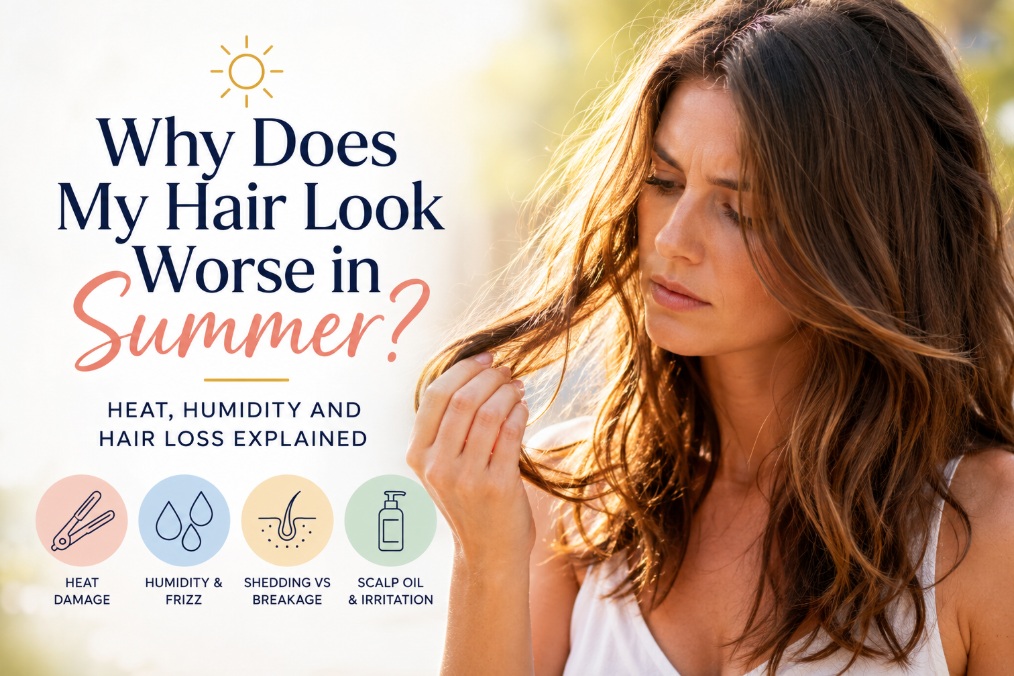
Summer is a season most of us look forward to. The longer days, warmer weather and holidays can do wonders for our mood, but they can also leave our hair feeling dry, frizzy and difficult to manage. If you’ve found yourself looking in the mirror and wondering why your hair suddenly seems thinner than it did a few weeks ago, you’re certainly not alone.
Every year, thousands of women search for answers after noticing more hair in the shower, flatter-looking roots or a wider-looking parting during the warmer months. It’s easy to assume that the heat itself is causing hair loss, but the reality is a little more complicated.
In most cases, summer doesn’t damage the hair follicle or permanently stop hair from growing. Instead, a combination of heat, humidity, UV exposure, increased sweating and frequent styling can make existing thinning hair much more noticeable. At the same time, hot weather can increase hair breakage, leaving your hair looking less full and healthy.
Understanding the difference between true hair loss and seasonal hair damage is the first step towards keeping your hair in the best possible condition throughout the summer. Here is summer hair loss explained.
Does Heat Actually Cause Hair Loss?
Simply spending time outdoors on a hot day isn’t usually enough to make your hair fall out.
Hair follicles sit several millimetres beneath the surface of the skin, where they’re well protected from everyday environmental temperatures. While prolonged sun exposure can damage the outer hair shaft, it’s unlikely to permanently damage healthy follicles.
That said, excessive heat can still affect how your hair looks and feels.
The outer layer of each strand, known as the cuticle, is made up of overlapping protective cells. High temperatures gradually weaken this protective barrier, allowing moisture to escape more easily. As hair becomes drier, it loses flexibility, making it more prone to snapping during brushing, styling or simply tying it back into a ponytail.
For women who already have fine or thinning hair, this extra breakage can create the impression that hair loss has suddenly accelerated, when in reality much of the problem lies within the hair shaft rather than the follicle itself.
Can Hair Dryers and Straighteners Make Hair Thinner?
The sunshine isn’t usually the biggest culprit. For many women, the real issue is how they style their hair during the summer.
Hair dryers, straighteners, curling wands and heated brushes all expose the hair shaft to temperatures that can exceed 200°C. Used occasionally and correctly, they’re unlikely to cause significant problems. Used every day on high heat, particularly without heat protection, they can gradually weaken the hair.
Repeated heat styling strips away moisture, roughens the cuticle and increases split ends. Over time, strands become increasingly fragile until they eventually snap.
This type of breakage is different from true hair loss.
If you’re noticing shorter hairs around your face or crown, frayed ends and uneven lengths, breakage is often the more likely explanation. By contrast, genuine hair shedding involves full-length hairs coming away from the scalp, often with a tiny white bulb attached to one end.
If you regularly use heated styling tools, a few simple adjustments can make a noticeable difference. Reducing the temperature, allowing hair to air dry before blow-drying, using a quality heat protectant and avoiding multiple passes with straighteners can all help preserve the integrity of the hair shaft.
Why Humidity Makes Thin Hair Look Even Thinner
One of the biggest frustrations during summer is humidity.
Even women with naturally healthy hair can struggle with frizz, but for those experiencing female pattern hair loss or naturally fine hair, humid weather often seems to make everything worse.
The reason lies in how hair reacts to moisture in the air.
Hair is surprisingly absorbent. When humidity levels rise, individual strands take in moisture from the surrounding environment. This causes the cuticle to lift slightly and the strands to swell unevenly. Instead of lying neatly together, hairs begin to separate, creating frizz and reducing smoothness.
Fine hair often loses volume at the roots while becoming puffier through the lengths. This combination can expose more of the scalp, making thinning appear much more obvious than it really is.
Many women assume they’re suddenly losing more hair, when in reality the change is largely cosmetic. The hair hasn’t necessarily become thinner overnight; it’s simply behaving differently because of the weather.
Humidity can also make hairstyles collapse more quickly. Hair that normally provides good coverage around the crown may flatten within an hour of leaving the house, again revealing areas of the scalp that weren’t previously visible.
Does Hot Weather Cause More Hair Shedding?
Some women genuinely notice more hair coming away during the summer, and there may be several reasons why.
Firstly, seasonal shedding is a recognised phenomenon. Research suggests that slightly more hairs naturally enter the resting, or telogen, phase during certain times of the year. While the increase is usually modest, women who are already monitoring their hair closely may become much more aware of it.
Secondly, people tend to wash their hair more frequently during hot weather. Sweat, sunscreen, salt water and chlorine often mean an extra shampoo or two each week.
Hair that was already ready to shed may simply be released during washing. Seeing dozens of hairs collected around the shower drain can be alarming, but those hairs were likely going to fall out anyway.
Sweat also causes loose hairs to cling together, making shedding appear heavier than it really is.
This is one reason why it’s important not to judge your hair health based on a single shower. Looking for gradual changes over several months provides a much more accurate picture than reacting to one day of increased shedding.
Can Hot Weather Make Your Scalp Oilier?
If your scalp seems greasy within a day of washing during the summer, you’re not imagining it.
Although heat doesn’t necessarily increase oil production dramatically, higher temperatures cause us to sweat more, and that sweat mixes with the scalp’s natural oils (sebum). The result is hair that feels heavier, flatter and dirtier much sooner than it does during the cooler months.
An oily scalp isn’t automatically a bad thing. Sebum helps protect both the scalp and hair shaft, but when excess oil combines with sweat, styling products and environmental pollution, it can leave hair looking limp and lifeless.
For women with fine or thinning hair, this can be particularly frustrating. Hair sticks together in thicker clumps, making gaps between the strands easier to see. Once again, it creates the illusion of worsening hair loss when the actual number of hairs hasn’t changed.
In some cases, warm, humid conditions can also encourage an overgrowth of Malassezia, a naturally occurring yeast found on the scalp. This can contribute to dandruff, itching and irritation. While dandruff itself doesn’t directly cause female pattern hair loss, persistent inflammation may increase shedding in some individuals, especially if scratching damages the scalp.
Keeping the scalp clean without over-washing is usually the best approach. A gentle shampoo suitable for your hair type, combined with occasional use of an anti-dandruff shampoo if needed, is often enough to keep excess oil and irritation under control.
Hair Breakage vs Hair Loss: How to Tell the Difference
One of the biggest misconceptions surrounding thinning hair is that every hair found on a hairbrush represents hair loss.
In reality, many women experiencing “hair loss” are actually dealing with excessive breakage.
The two problems can look remarkably similar in the mirror, but they’re caused by very different processes.
Hair breakage occurs when the strand snaps somewhere along its length. This is often linked to repeated heat styling, bleaching, tight hairstyles, harsh brushing or environmental damage. The follicle remains healthy and continues producing new hair, but the existing strands become shorter and weaker.
True hair loss, on the other hand, begins beneath the scalp. The follicle sheds the entire hair, usually complete with its tiny white root bulb. Depending on the underlying cause, the follicle may produce another healthy hair, a progressively finer one, or, in some conditions, stop producing hair altogether.
A few simple clues can help you tell the difference.
If you’re finding lots of shorter hairs around your sink, noticing split ends or seeing uneven lengths throughout your hair, breakage is often to blame.
If you’re seeing full-length hairs coming away from the root, noticing a widening parting or gradually seeing more scalp over several months, genuine hair thinning may be occurring.
Sometimes, of course, both problems happen together. A woman with early female pattern hair loss who also regularly uses straighteners may experience both reduced hair density and increased breakage, making her hair appear considerably thinner than either issue would cause on its own.
How to Protect Your Hair During the Summer
Fortunately, you don’t have to spend the entire summer hiding indoors to keep your hair healthy.
Small changes to your routine can make a surprisingly big difference.
Try to avoid using the highest heat settings on hair dryers and straighteners whenever possible. Allow your hair to air dry for a few minutes before blow-drying, and always apply a heat protectant if you’re using heated styling tools.
If you’ll be spending several hours in strong sunshine, wearing a hat or scarf helps protect both the hair shaft and your scalp from prolonged UV exposure. This is particularly worthwhile if your hair is already fine, colour-treated or naturally dry.
Swimming is another common source of damage during the summer. Chlorine and salt water don’t usually cause permanent hair loss, but they can dry out the hair and increase breakage. Rinsing your hair with fresh water before and immediately after swimming helps minimise this effect.
Nutrition also plays an important role. Hair is made primarily from protein, and healthy growth depends on an adequate supply of nutrients including iron, zinc, vitamin D, biotin and several B vitamins. While no supplement can compensate for an underlying medical condition, maintaining good nutritional status gives your follicles the building blocks they need to produce strong, healthy hair.
If you’re already concerned about thinning hair, you may also wish to consider a scientifically formulated hair supplement designed to support normal hair growth from within. Products such as HR23+ combine vitamins, minerals, amino acids and botanical extracts that work together to support healthy hair follicles as part of an overall hair care routine.
When Should You Be Concerned?
While seasonal changes often make thinning hair more noticeable, persistent or rapidly worsening hair loss shouldn’t simply be dismissed as a summer problem.
If your hair has been shedding excessively for more than three months, your parting is becoming progressively wider, you’re developing bald patches or you’re experiencing significant scalp pain or itching, it’s worth speaking to your GP or a dermatologist.
Hair loss in women can have many different causes, including iron deficiency, thyroid disorders, hormonal changes, nutritional deficiencies, autoimmune conditions and female pattern hair loss. Identifying the underlying cause early often gives you the best chance of slowing progression and improving long-term outcomes.
The Bottom Line
It’s easy to blame the weather when your hair suddenly seems thinner in July, but the reality is usually more reassuring.
Heat, humidity and sunshine rarely cause permanent hair loss on their own. What they can do is expose existing thinning, increase breakage, flatten fine hair, create frizz and leave your scalp feeling oilier than usual. Together, these changes can make your hair appear dramatically different, even though the number of healthy follicles hasn’t changed.
By protecting your hair from excessive heat styling, managing humidity as well as possible and supporting healthy hair growth through good nutrition and sensible hair care, you can help your hair stay stronger and healthier throughout the summer months.
If your hair continues to thin long after the weather cools down, however, don’t ignore it. Persistent hair loss is worth investigating, and early treatment is often far more effective than waiting until the problem becomes more advanced.

Leave a Reply