
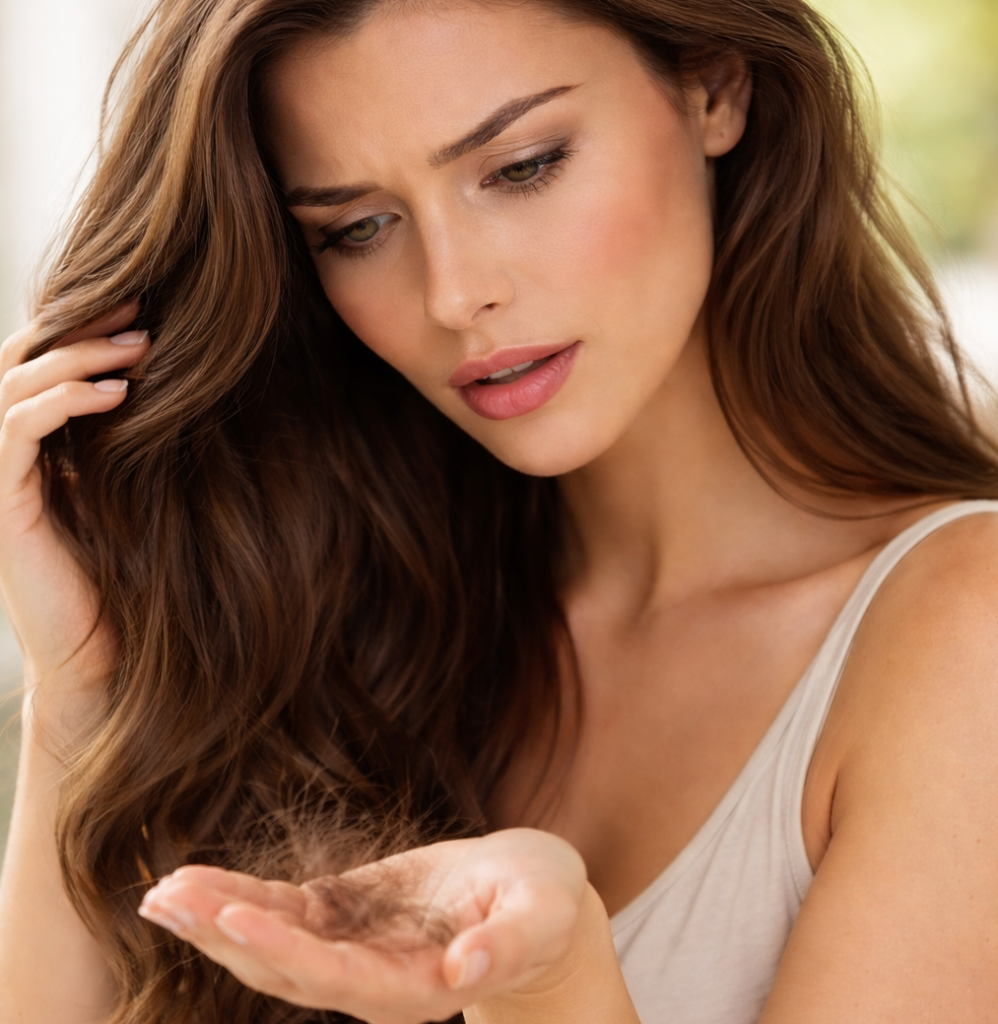
Most women don’t wake up one morning, stare into the mirror, and think: I’m losing my hair.
That moment usually comes much later.
Hair loss in women is rarely dramatic. It doesn’t announce itself with bald patches or sudden shedding (at least not at first). Instead, it slips in quietly—almost politely—changing things just enough for you to doubt your own perception.
Your ponytail feels thinner.
Your part looks a little wider.
Your hair doesn’t behave the way it used to.
And then comes the most unsettling part: no one else seems to notice… so you wonder if it’s all in your head.
It isn’t.
Hair Loss Isn’t Always About Hair
One of the biggest myths around female hair loss is that it’s primarily a hair problem. In reality, it’s usually a systemic one.
Hair is a luxury tissue. Your body prioritises survival first—heart, brain, lungs—then everything else. Hair growth only happens when your internal environment feels safe, nourished, and balanced.
Stress, calorie restriction, hormonal shifts, inflammation, gut issues, iron depletion, thyroid imbalance—any one of these can quietly pull resources away from your hair follicles.
That’s why women often experience hair thinning without excessive shedding, without bald spots, and without obvious “falling out.” The growth cycle simply slows. Hair strands become finer. Fewer hairs re-enter the growth phase.
By the time the change is visible, the internal signal has been there for months.
The Invisible Triggers No One Talks About
Many women with hair loss are doing everything “right”:
- Eating clean
- Exercising regularly
- Managing busy lives
- Taking multivitamins
Yet hair continues to thin.
Why?
Because female hair loss is often driven by subtle signals, not dramatic deficiencies.
Things like:
- Long-term mental stress (even when you feel “functional”)
- Chronic under-fueling or low protein intake
- Post-pill hormonal shifts
- Perimenopause and cortisol dominance
- Inflammation from ultra-processed foods
- Poor mineral absorption despite supplementation
Hair follicles are exquisitely sensitive. They respond to nuance, not extremes.
And this is why blanket advice like “just take biotin” so often fails.
Why Shampoo Isn’t the Answer (But Still Sells Well)
Walk into any shop and you’ll find shelves of “hair growth” shampoos and miracle serums.
Here’s the uncomfortable truth:
Topical products don’t tell hair follicles to grow.
They may improve scalp health, reduce breakage, or make hair appear thicker—but growth itself is governed internally, at the cellular and hormonal level.
Think of it like watering leaves instead of nourishing roots.
Without the internal building blocks—amino acids, minerals, antioxidants, and growth-supporting peptides—the follicle stays dormant, no matter how luxurious the shampoo.
Hair Growth Is a Biological Signal
Hair grows when the body receives a very specific message:
“We’re safe. We have enough. You can invest energy here.”
That message is delivered through:
- Adequate protein and amino acids
- Trace minerals like zinc, copper, selenium, iodine
- Growth-supporting peptides
- Reduced inflammation and oxidative stress
- Balanced stress hormones
Miss a few of these for long enough, and hair growth quietly steps aside.
This is where targeted supplementation—not generic multivitamins—can make a meaningful difference.
Where HR23+ Fits In
Unlike trend-led hair supplements that rely on flashy ingredients, HR23+ was developed with one core principle in mind:
support the hair growth environment, not just the hair.

HR23+ focuses on nutrients and bio-active compounds that:
- Support normal hair growth cycles
- Help protect follicles from oxidative stress
- Aid nutrient delivery at the cellular level
- Complement the body’s natural signalling systems
Rather than forcing growth, the goal is to remove the barriers that stop hair from growing as it should.
Many women don’t need stimulation.
They need permission—metabolically speaking—for hair growth to resume.
Why Women Blame Themselves (And Shouldn’t)
One of the saddest patterns we see with hair loss is self-blame.
Women assume they’ve done something wrong:
- “Maybe I damaged it with colouring”
- “Maybe it’s my age”
- “Maybe this is just my genetics”
Yet many of these same women had thick, vibrant hair well into adulthood—until stress, hormonal disruption, or nutritional imbalance quietly shifted the internal terrain.
Hair loss is not a personal failure.
It’s feedback.
Your body is communicating that something needs support.
The Power of Catching It Early
The earlier hair thinning is addressed, the more responsive follicles tend to be.
Dormant follicles can re-enter the growth phase—but they don’t stay dormant forever. Over time, they can miniaturise and shut down completely.
Early intervention isn’t about panic.
It’s about awareness.
Listening to the subtle changes before they become obvious ones.
A Different Way to Think About Hair Health
Instead of asking:
“How do I make my hair grow faster?”
A better question is:
“What’s stopping my hair from growing right now?”
That shift—from force to support—is often the turning point.
Hair regrowth is rarely instant. It’s gradual, cumulative, and deeply linked to how well your body feels nourished and regulated.
Which is also why women often notice unexpected side effects when hair growth improves—better energy, stronger nails, improved skin resilience.
Hair doesn’t exist in isolation.
Final Thoughts: Hair as a Quiet Measure of Well-Being
Hair is one of the most emotionally charged aspects of our appearance—yet it’s also one of the most honest reflections of internal health.
When it thrives, it’s because the body feels secure enough to invest in beauty, not just survival.
And when it struggles, it’s not asking for harsh fixes or quick wins.
It’s asking for understanding, support, and patience.
Sometimes, the most powerful thing you can do for your hair…
is listen to what it’s been trying to tell you all along.

Leave a Reply