
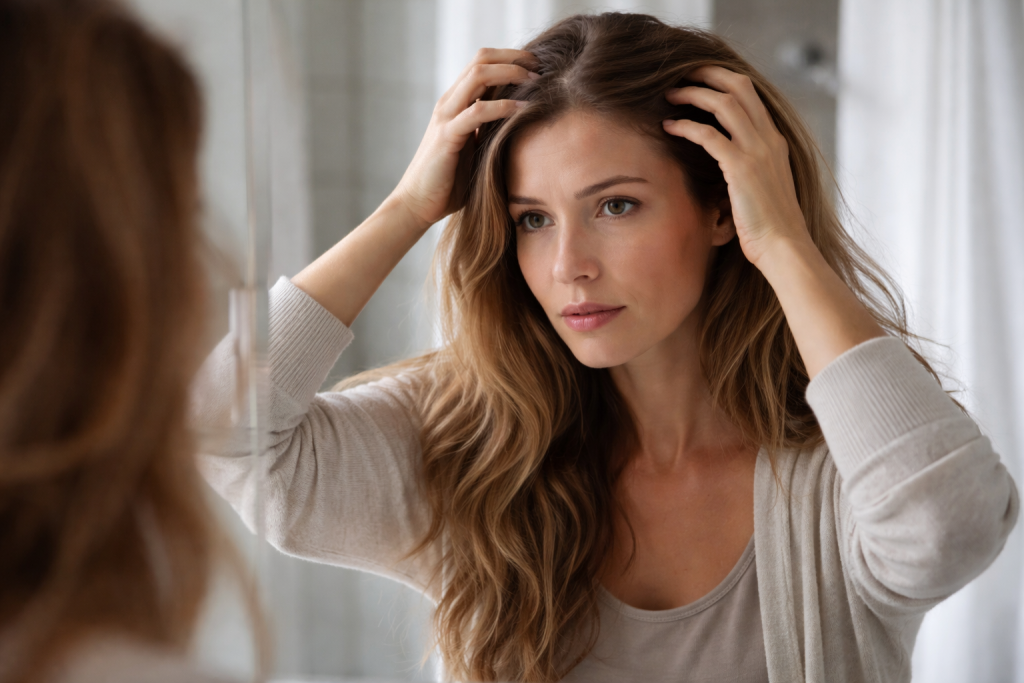
There’s a moment most women don’t talk about.
It doesn’t happen under bright salon lights or in front of friends.
It happens alone — usually in the bathroom, sometimes in a car mirror, often in silence.
You tilt your head differently.
You part your hair again.
You pull it forward, then push it back.
And suddenly, without drama or panic, a thought lands:
“This isn’t what it used to be.”
Not bald. Not falling out in clumps.
Just… different.
A little flatter at the crown.
A bit more scalp showing in photos.
A ponytail that feels thinner than you remember.
Female hair loss rarely announces itself loudly.
It whispers.
And because it whispers, most advice online completely misses the point.
Hair Loss Isn’t Just Hair — It’s Identity
Here’s what most articles get wrong.
They talk about hair loss as a problem to fix, when for women, it’s often experienced as a loss of self.
Your hair has been:
- Part of your femininity
- A shield on bad days
- A confidence booster when you needed one
- Something you never thought about — until it changed
That’s why phrases like “it’s just hair” feel so dismissive.
Because it’s never just hair.
Female hair loss doesn’t always come with medical labels or obvious triggers. Sometimes it arrives subtly during:
- Post-pregnancy life
- Perimenopause
- Recovery from long stress
- Weight changes
- Illness
- Or simply… time
And the hardest part?
You’re often expected to stay calm, grateful, and rational while something deeply personal slips away.
Why Most Hair Loss Advice Fails Women
Search for help online and you’ll see the same recycled content:
- “Get your iron checked”
- “Balance your hormones”
- “Reduce stress”
- “Use gentle shampoos”
None of this is wrong — but none of it tells the full story either.
Because hair loss isn’t a single-cause issue.
It’s a cumulative signal.
Hair is one of the last systems in the body to be prioritised. It grows when:
- Nutrients are abundant
- Inflammation is low
- Hormones are steady
- The nervous system feels safe
When something is off for long enough, hair growth quietly down-regulates — like a non-essential luxury your body puts on pause.
That’s why women often feel gaslit by their own experience:
“My blood tests are normal… so why does my hair feel wrong?”
The Hidden Phase Nobody Talks About: The In-Between
There’s a stage of hair change that doesn’t have a name.
You’re not sick.
You’re not visibly balding.
But you know something is shifting.
This in-between phase is where most women live for years — buying new styling products, changing partings, cutting layers, switching supplements — without a clear strategy.
This is also where shame sneaks in.
You hesitate to talk about it because:
- “Other women have it worse”
- “I don’t want to sound vain”
- “Maybe I’m imagining it”
You’re not.
And you’re not alone.
Hair Needs More Than Hope — It Needs Building Blocks
Hair doesn’t regrow because of motivation or positive thinking.
It regrows when the environment becomes supportive again.
That means thinking differently about hair support — not as a quick fix, but as long-term nourishment.
Hair fibres are made primarily from protein, minerals, and micronutrients involved in cell division and follicle signalling. Over time, depletion adds up.
This is where targeted supplementation can play a meaningful role — if it’s done properly.
Not with scatter-gun multivitamins.
Not with trend-driven ingredients.
But with formulas designed specifically for hair biology, not general wellness.
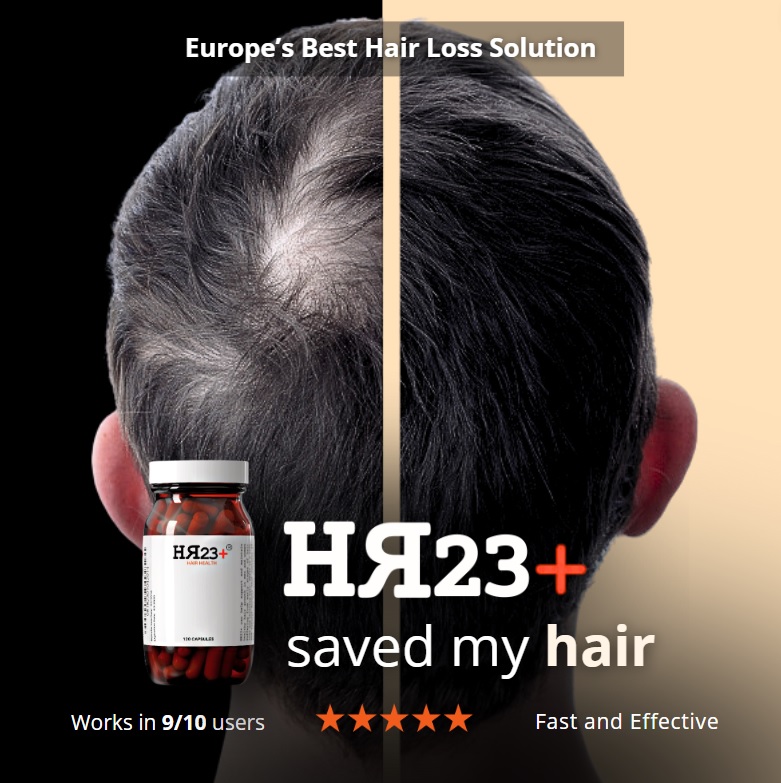
That’s why many women exploring hair recovery turn to supplements like HR23+ — a formulation developed with hair-specific nutrients and bioavailable forms designed to support follicles from the inside out.
It’s not positioned as a miracle.
It’s positioned as support — the kind hair actually responds to over time.
The Power of Consistency (Not Perfection)
One uncomfortable truth:
Hair recovery is slow.
Slower than skin.
Slower than energy levels.
Slower than weight changes.
Which is why consistency matters more than intensity.
Women who see improvements aren’t usually doing everything.
They’re doing a few key things, repeatedly:
- Supplying nutrients daily
- Reducing chronic inflammation
- Supporting hormonal transitions gently
- Giving hair time to re-enter growth cycles
This is a months-long conversation with your body — not a 30-day challenge.
And yes, it requires patience.
But it also offers something many women haven’t felt in a while:
Agency.
When Hair Becomes a Teacher
Many women say something unexpected happens during this journey.
They stop punishing their bodies.
They start listening instead.
Hair becomes less of an enemy — and more of a messenger.
It reflects:
- How nourished you are
- How stressed your system has been
- Whether your body feels supported
In that way, hair loss isn’t a failure.
It’s feedback.
And once you understand that, everything shifts.
A Different Way Forward
If you’re reading this because your hair doesn’t feel like you anymore, here’s the truth no one tells you:
You don’t need to panic.
You don’t need to accept decline.
And you don’t need to chase extremes.
You need support, time, and the right inputs.
Whether that includes lifestyle changes, better nutrition, stress reduction, or a hair-specific supplement like HR23+, what matters most is that you stop dismissing your own experience.
Your concern is valid.
Your intuition is real.
And your hair story isn’t over.
Sometimes, it’s just beginning — quietly, patiently, from the inside out.
Leave a Reply